At Four Oaks Primary School, we believe that geography is the key to understanding the world we live in – its landscapes, its people, and the connections between them. Our curriculum is designed to inspire curiosity, encourage exploration, and develop pupils’ knowledge of both their local environment and the wider world. By combining the structure of the National Curriculum with rich, hands-on experiences such as fieldwork, local studies, and visits to contrasting locations, we ensure that geography learning is both meaningful and memorable. Pupils are encouraged to think like geographers: asking questions, interpreting maps, analysing data, and considering how human and physical processes shape the places around us. Through this, they gain the skills, knowledge, and global awareness needed to make informed decisions and to take an active role in caring for our planet.
Further Information:
Progressions Maps:
Geography Curriculum Intent
At Four Oaks we are geographers! We want our children to love Geography. We want them to have no limits to what their ambitions are and grow up enabled to become cartographers, town planners, conservationists or weather forecasters. We want them to embody our core values: we all “strive to be the best we can be”. We want our children to remember their Geography lessons in our school, to cherish these memories and embrace the geographical opportunities they are presented with!
In Year Four, pupils enjoy an enrichment trip charting the journey of the River Alt. The children use their classroom learning in context, identifying river features and adjacent land use at different points along the river. They learn how land drainage and marsh land in Huyton quickly develops into a river, gathering pace and changing shape and direction as it flows towards its mouth at Hightown. As with all other stages of the geography curriculum at Four Oaks, this experience is part of a wider learning experience. In Year 5, the children visit this area again, observing a panorama of the floodplains and flat farmland of Altcar and Formby, comparing its uses with that of the fertile Grésivaudan valley on the banks of the Isère river in France. In History and Geography in UKS2, the children are able to revisit and broaden their learning through topics looking at the docklands of Liverpool, their use and importance through time and their resurgence through regeneration and gentrification.
For many children, these experiences and the locations studied are new to them. In KS1, the children particularly focus on the local area, including conducting fieldwork studies. For example, in Year 1, one child commented, “I liked when we went out and we counted the cards to see which road is the busiest.” They also gain opportunity to look at geography further afield. For example, a child in Year 2 said “When we looked at Kenya, we went there as a class! We used Google maps and could see and experience different parts like the savannahs and parks.” Bringing Geography alive is important at Four Oaks Primary School.
The geography curriculum promotes curiosity and a love and thirst for learning and, as in all curriculum areas, empowers our children to become independent and resilient learners and citizens.
We want to equip our children, not only with the minimum statutory requirements of the Geography National Curriculum, but to prepare them for the opportunities, responsibilities and experiences of later life. For example, in collaboration with the History curriculum, our children have the opportunity to enjoy a culture and immigration tour of the streets of Liverpool. This allows the children to witness first-hand how the geography and social fabric of the city has changed over time and therein its main purposes: from fortification and garrisons, to trade, migration and tourism. The children discover more about their local history and take pride in its achievements whilst also reflecting on its mistakes. They have the opportunity to incorporate map work, including OS maps, into these studies. The knowledge and understanding harvested by the children in this Year 5 History topic is advanced in Year 6. An ambitious case study, comparing the regeneration and gentrification of Liverpool One and the Albert Dock with the similar experience of New York’s Meatpacking District further builds on the children’s learning. It also allows them to develop fieldwork skills, including through social interaction with the general public – readying them in the summer term for their move into secondary education.
We want our children to use the vibrancy of our great city and surrounding areas to learn from other cultures, respect diversity, co-operate with one another and appreciate what they have. We achieve this by providing a SMSC curriculum with Four Oaks’ British ‘Golden’ Values at the heart of everything we do. This often feeds into the geography curriculum. To further enrich the geography curriculum, it is connected with other areas of the curriculum. Year 5’s Geography-History tour of the streets of Liverpool with strong connection to migration and the enrichment of the city’s cultural stew. Liverpool’s original seven streets (detailed earlier) also provided the children with a great opportunity to develop local pride and to contextualise it with the wider issues of British Values. This was particularly the case when thinking about how these values had shifted over time with specific regard to the Slave Triangle. Year 6 are able to build on this through land use study and change over time, with particular focus on the Liverpool One/Albert Dock areas of the city. This also develops the children’s cultural knowledge and understanding, both locally and how this influence expanded worldwide. We enrich the children’s time in our school with memorable experiences and provide opportunities which may otherwise be out of reach.
We firmly believe that developing well rounded, lifelong learners is not just about what happens in the classroom, it is about the added value we offer that will really inspire our children.
Geography Curriculum Implementation
We implement a curriculum that is progressive throughout the whole school. Geography is taught over three half terms per year, focusing on knowledge and skills stated in the National Curriculum. This helps to ensure sufficient time is allocated to Geography and that subject matter can be revisited. We believe that by crafting our curriculum this way, we improve the potential for our children to retain what they have been taught, to alter their long-term memory and thus improve the rates of progress they make. At the beginning of each topic, children are able to convey what they know already as well as what they would like to find out – Geography’s own Curious Minds model. This ensures that lessons are relevant and take account of children’s different starting points.
The geography curriculum at Four Oaks Primary School is based upon the 2014 Primary National Curriculum in England, which provides a broad framework and outlines the knowledge and skills taught in each Key Stage. The geography curriculum has been very carefully designed: identifying school-specific drivers and strands to run through all key stages; connecting and revisiting topics and key themes; identifying and highlighting prior learning and future learning; choosing relevant and engaging topics/themes/locations; creating clear and concise MTPs for staff to follow to ensure greater standardisation. Geography teaching focuses on enabling children to think as geographers. Geography provides opportunities to enhance the learning of all pupils through fieldwork, analysing data, map reading and making, and producing reports. All topics are titled with questions – children use their learning from throughout the topic to answer these questions.
Educational visits are another important opportunity for the teachers to plan for additional geography learning outside the classroom. At Four Oaks Primary School, the children have many opportunities to experience Geography on educational visits as per some examples above. It is written into the curriculum that all classes should undertake at least one field visit per year. These are outlined and earmarked in coverage and MTP documents. In addition, KS2 pupils have the opportunity to visit different geographical locations (such as residential visits, water sports, fieldwork and land use studies and land use over time.)
On a half-termly basis, a whole-school challenge is presented to the children: a poster of a geographical phenomenon. The children are challenged to make observations and/or try to explain what they see. A video and explanatory blurb is provided for the children in the last week of the half-term, whilst child contributions are collected and celebrated in a ‘Wonders’ presentation book. The prime aim of this is to inspire a sense of awe and wonder in the natural world and to develop the children’s ability to communicate this in reflective writing.
We develop the following essential characteristics of geographers:
- A knowledge and understanding of the world around them – locally, nationally and globally.
- The ability to read a range of maps (including reading compass points) and to create their own.
- To conduct a range of fieldwork activities to engage more closely with their environment, and to assess/challenge hypotheses.
- The ability to think about and discuss important issues affecting the planet today such as deforestation and climate change and to form reasoned opinions or arguments.
- A passion for geography and an enthusiastic engagement in learning, which develops their sense of curiosity about their environment and the wider world.
Geography Curriculum Impact
The teachers complete tracking documents which detail any pupils who have not fully grasped a concept or skill. It is not uncommon for there to be a nil return or a very small number of pupils listed. Any pupil who has not confidently grasped a skill or knowledge will be supported through one or more of the following interventions:
- Keep up
- Catch up
- Pre-teach
This section should be read in conjunction with our Assessment and Interventions document found here.
Knowledge Organisers:
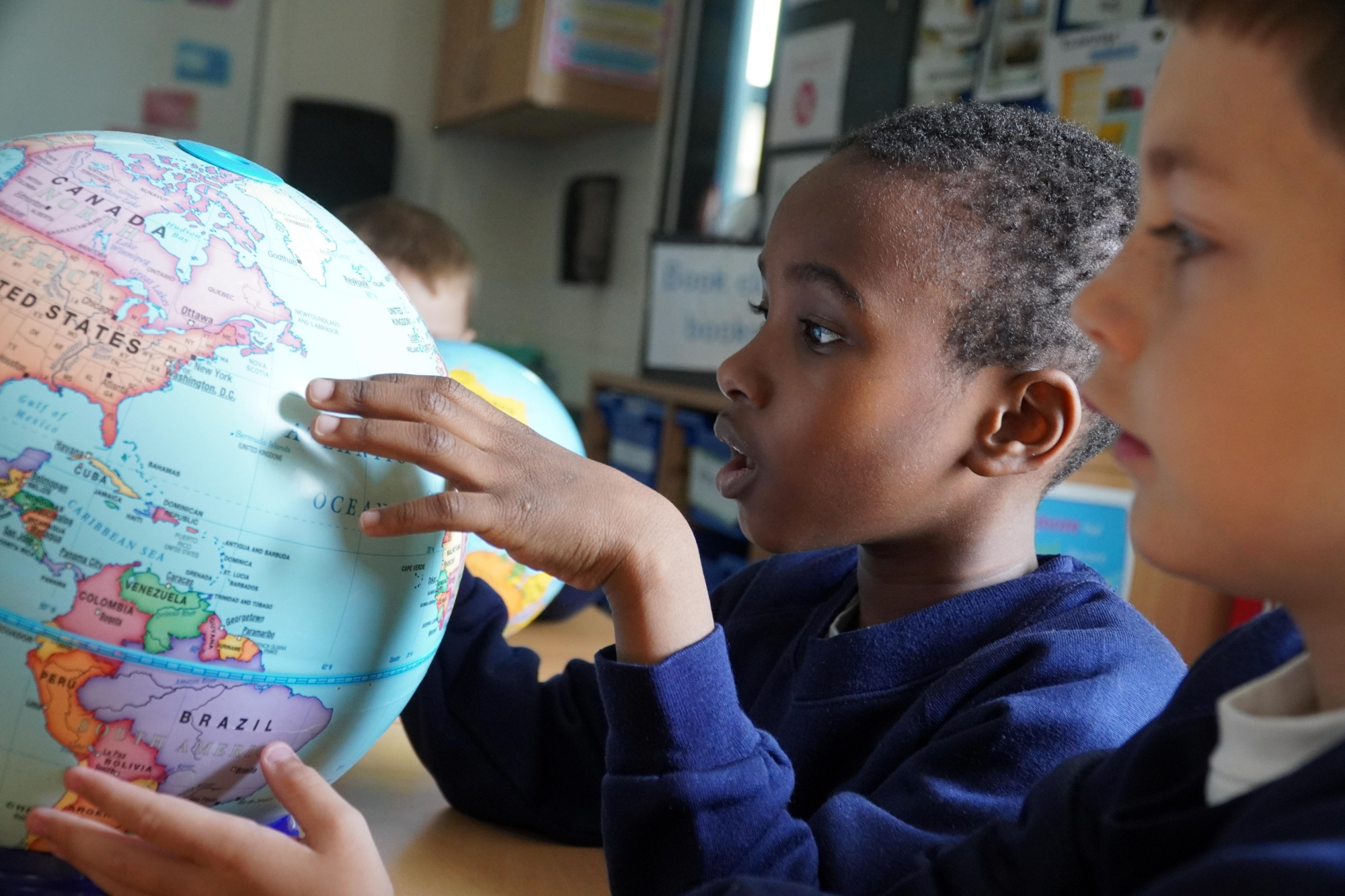
Geography In Action


