At Four Oaks Primary School, we are committed to developing confident, curious, and capable mathematicians. We believe that mathematics is not only a vital life skill but also a powerful way of thinking that enables children to solve problems, make decisions, and understand the world around them. Our curriculum is ambitious, engaging, and built to ensure fluency, reasoning, and problem-solving skills are developed progressively across all year groups. Through practical activities, exploration, and discussion, pupils gain both the conceptual understanding and the confidence to apply their knowledge in real-life contexts. By combining the rigour of the National Curriculum with rich, memorable learning experiences, we aim to nurture resilient learners who enjoy mathematics, value its relevance, and are fully prepared for the opportunities and challenges of later life.
Further Information:
Progression Maps:
Mathematics Curriculum Intent
At Four Oaks, we are mathematicians! We want our children to love maths. We want them to have no limits to what their ambitions are and grow up enabled to become counters, calculators, problem solvers, puzzlers or analysts. We want them to embody our core values: we all “strive to be the best we can be”. We want our children to remember their maths lessons in our school, to cherish these memories and embrace the mathematical opportunities they are presented with! Our lessons contain practical activity, exploration and discussion to develop confidence and competence with numbers and the number system. We recognise that strategies are needed to develop the ability to solve problems through decision-making and reasoning in a range of contexts aimed to help children understand the importance of mathematics in everyday life.
A practical understanding of the ways in which information is gathered and presented allows us to explore features of shape and space and develop measuring skills in a range of contexts. We want our children to become fluent in the fundamentals of mathematics through varied and frequent practice with increasingly complex problems over time, so that pupils develop conceptual understanding and the ability to recall and apply knowledge rapidly and accurately. They can then reason mathematically by following a line of enquiry, conjecturing relationships and generalisations, and developing an argument, justification or proof using mathematical language. Bringing maths alive is important at Four Oaks Primary School.
We encourage this through themed days: KS1 participated in a ‘Numbots Day’ where the children could dress up as their avatar and bring maths alive in the classroom through completing a wide range of mathematical challenges. KS2 participated in a ‘TT Rockstars Day’, dressing up as their rock star avatar and competing with other children across school to improve their mathematical fluency. A child in KS2 expressed, ‘I had fun competing against my peers but I really enjoyed challenging my teachers and moving up our class leader board.’
The maths curriculum promotes curiosity and a love and thirst for learning. It is ambitious and, as in all curriculum areas, empowers our children to become independent and resilient learners and citizens. We want to equip our children, not only with the minimum statutory requirements of the Maths National Curriculum, but to prepare them for the opportunities, responsibilities and experiences of later life. For example, children in UKS2 participate in a ‘Maths Challenge Day’ which brings children together from local schools to take part in problem solving challenges in a competitive format. A Year 6 child shared, ‘I enjoyed the experience of competing with children I’ve never met and working as a team to complete challenging problems under a time limit.’ Data handling skills are practiced and developed through conducting surveys and use of graphs. For instance, ‘Sports Day’ provides opportunities for children to collect and represent data and children are encouraged to represent data in various ways during their science lessons. Our environment lends itself to many opportunities for measurement and related calculations. The MUGA, the playground and the indoor areas are often used to supplement these maths related activities such as orienteering. Maths is well resourced, allowing for practical sessions that involve children gaining hands on experience with a variety of representations of problems and calculations.
The pupils thoroughly enjoy these experiences with many children remarking in ‘Pupil Voice’ discussions that Maths is their favourite subject. We enrich the children’s time in our school with memorable experiences and provide opportunities which may otherwise be out of reach.
We firmly believe that developing well rounded, lifelong learners is not just about what happens in the classroom, it is about the added value we offer that will really inspire our children.
Mathematics Implementation
We implement a curriculum that is progressive throughout the whole school focusing on knowledge and skills stated in the National Curriculum. Our curriculum provides opportunities for our children to consolidate and build on what they have been taught, to alter their long-term memory and thus improve the rates of progress they make.
The Maths curriculum at Four Oaks Primary School is based upon the 2014 Primary National Curriculum in England, which provides a broad framework and outlines the knowledge and skills taught in each Key Stage. Teachers plan lessons based on both the required curriculum coverage and the children’s interests. A variety of teaching approaches are used based on teacher judgement, ensuring progression of knowledge and skills from year group to year group. Maths teaching focuses on enabling children to think as mathematicians.
Maths provides opportunities to enhance the learning of more able pupils through investigations, problem solving, reasoning and analysing sources.
At Four Oaks Primary School, we provide a variety of opportunities for maths learning inside and outside the classroom. For example, we integrate maths learning opportunities into other areas of the curriculum and link aspects of topics to direct maths concepts. There are many opportunities that teachers take to develop mathematic themes, from timelines in history to scientific investigations, to design or art tasks that look at measurement or patterns.
We develop the following essential characteristics of mathematicians:
- A knowledge of the number system.
- A grasp of the ways in which the number system provides some structure to understanding, ordering and explaining our world.
- A mathematical knowledge and vocabulary.
- Fluency in complex, mathematical enquiry and the ability to apply questioning skills and use effective analytical and presentational techniques.
- The ability to reach clear conclusions based on available evidence and develop a reasoned argument to explain findings.
- Strategies to tackle and develop ideas to provide interpretations and representations of the subject matter.
- Utilise mathematical skills and techniques to work through problems and investigations.
mathematics
curriculum impact
Assessments are carried out regularly in mathematics. We use both formative and summative assessment information in every mathematics lesson. Staff use this information to inform their short-term planning and short-term interventions. This helps us provide the best possible support for all of our pupils, including the higher attainers. If children are keeping pace with their year group curriculum, they are deemed to be making expected or more than expected progress if they started from a low entry point.
We measure the impact of our curriculum through the following methods:
- Interviewing the pupils about their learning (pupil voice)
- Termly reporting of standards across the curriculum
- Analysis of termly standardised tests
- End of Key stage SATs results.
As a result of our maths teaching at Four Oaks you will see:
- Engaged children who are challenged.
- Confident children who can all talk about maths and their learning and the links between mathematical topics.
- Lessons that use a variety of manipulatives to support learning and understanding.
- Different representations of mathematical concepts
- Learning that is tracked and monitored to ensure all children make good progress.
Aims of Maths:
The national curriculum for mathematics aims to ensure that all pupils:
-
Foster curiosity and a love of mathematics by inspiring children to enjoy maths, explore patterns and numbers, and develop lifelong interest and ambitions in mathematical thinking.
-
Develop mathematical knowledge and understanding by building skills in number, shape, space, measurement, and data handling progressively from Nursery to Year 6.
-
Promote mathematical skills and thinking by enabling children to reason, solve problems, carry out investigations, and apply strategies independently.
-
Encourage critical thinking and problem-solving by supporting children in explaining their reasoning, making connections, and applying maths to real-life situations.
-
Connect mathematics to the wider world by providing practical, hands-on experiences through experiments, surveys, themed days, educational visits, and cross-curricular links.
NuRSEry
The Nursery curriculum focuses on developing children’s early understanding of numbers, shapes, and patterns through play, exploration, and everyday experiences.
- Young children in early mathematics enjoy counting aloud and exploring numbers through play. They learn to point to each item while counting, understanding that the last number represents the total, and begin to recognise numerals up to ten, linking them with small quantities. They can subitise one to three objects and compare small groups to see when sets are equal.
- Children start exploring addition and subtraction, recognising that numbers are made of smaller parts and that each number is one more than the last. They solve simple problems by separating and recombining objects. Measurement is introduced through everyday experiences, comparing length, weight, and capacity. In geometry, children explore 2D and 3D shapes, use positional language, and create simple spatial and repeating patterns.
REception
The Reception curriculum focuses on developing children’s early mathematical, literacy, and personal skills through play and practical experiences.
- Children develop a deeper understanding of numbers, counting verbally from 0 to 10 and beyond, and counting objects accurately from a larger group. They begin to subitise small quantities, order numerals, and match numbers to groups of items, showing awareness of quantity and relative size. Children use number names and symbols to compare numbers and explore larger numbers with growing curiosity.
- Through play and practical activities, they explore addition and subtraction, using strategies of their choice, including numerals, tallies, or signs. They understand that numbers are made up of smaller parts, add or subtract one from numbers up to 10, and begin to subitise larger numbers by recognising smaller groups within them.
- In measurement, children compare length, weight, and capacity, use everyday tools, and sequence events using time-related language. They explore 2D and 3D shapes, combine and partition them to build models, develop spatial reasoning, use positional language, and create repeating patterns in their environment.
Key Stage 1
The curriculum overview for Year 1 and Year 2 Mathematics is designed for a smooth progression in number fluency and mathematical reasoning.
- Year 1 establishes the core building blocks for mathematics. Children focus on mastering place value and addition/subtraction facts initially within 10, then extending the numerical range up to 100 by the end of the year. The concepts of multiplication and division are introduced visually through grouping and sharing. Fractions are limited to recognising and finding halves and quarters of shapes and small quantities. Measurement covers comparing length, weight, and volume, alongside learning to tell time to the hour and half-hour and identifying money. Geometry involves naming and classifying basic 2D and 3D shapes.
- Year 2 consolidates and significantly expands upon Year 1 skills by formalising methods. Place value is secured up to 100, which enables children to use more formal written methods for addition and subtraction involving two 2-digit numbers. Fluency is developed through the recall of the 2, 5, and 10 times tables and corresponding division facts. Fractions are expanded to include thirds and finding fractions of quantities. In measurement, pupils transition to using standard units and learn to tell time precisely to the nearest 5 minutes and calculate change. Statistics is also introduced, focusing on reading and interpreting simple data charts.
Key Stage 2
Key Stage 2 builds on the foundations laid in Key Stage 1, developing children’s confidence, fluency, and reasoning in mathematics.
- In Year 3, children work with numbers up to 1,000, learning to count in steps of 50 and 100, compare and order numbers, and identify 1, 10, or 100 more or less. They use formal methods for addition and subtraction with up to three-digit numbers, focus on the 3, 4, and 8 times tables, and begin multiplying two-digit numbers by one-digit numbers. Pupils are introduced to simple fractions, finding fractions of quantities, and adding or subtracting fractions with the same denominator. Measurement covers length, perimeter, mass, capacity, and time, including the 24-hour clock, while in geometry and statistics, children explore right angles, basic shapes, and simple bar charts and pictograms.
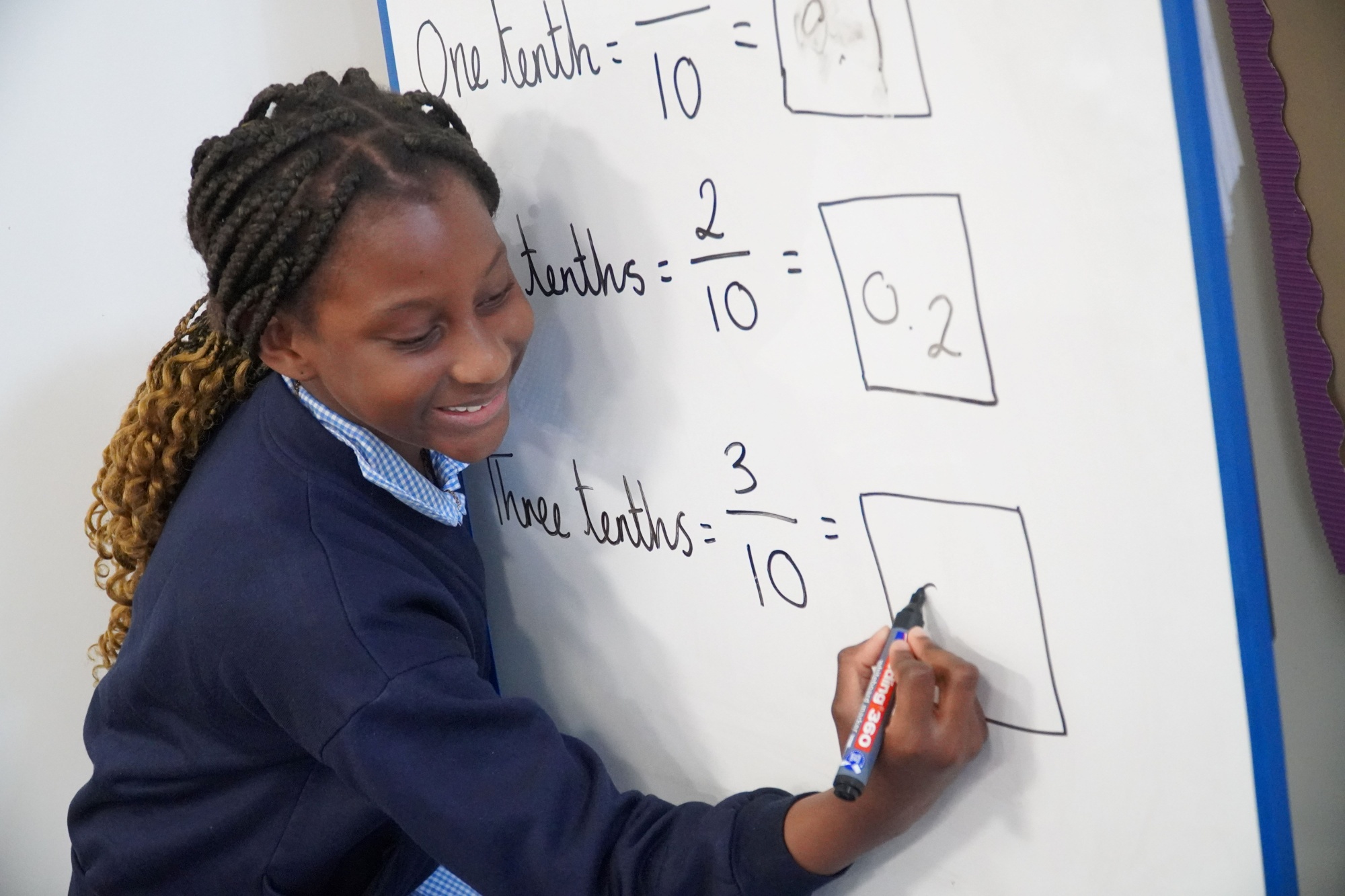
- Year 4 extends learning to numbers up to 10,000, counting in multiples of 6, 7, 9, 25, and 1,000, and rounding to the nearest 10, 100, or 1,000. Pupils apply formal methods to four-digit addition and subtraction, short multiplication, and short division. They find equivalent fractions, convert fractions to decimals, calculate area by counting squares, convert units, and explore angles, lines, and coordinates in the first quadrant.
- In Year 5, numbers reach 1,000,000, including negative numbers and Roman numerals, with rounding to larger units. Pupils use long multiplication and short division, consolidate fractions, decimals, and percentages, and calculate areas and angles accurately, beginning to explore imperial measures.
- Year 6 consolidates all prior learning with numbers to 10,000,000, long division, BODMAS, ratio, and percentages. Pupils calculate areas of triangles and parallelograms, volume of cuboids, explore 2D and 3D shapes, plot coordinates across all quadrants, and find the mean, applying skills to more complex problems.
Maths In Action
.png?v=1789673189)

.png?v=1789673189)
