At Four Oaks Primary School, we are dedicated to fostering curiosity, creativity, and a deep understanding of the world through science. We believe that science education should inspire awe and wonder, encourage questioning, and equip children with the skills to investigate, analyse, and draw meaningful conclusions. Our curriculum is designed to be ambitious, engaging, and inclusive, ensuring that all pupils develop the knowledge, vocabulary, and practical skills to think and work like scientists. By combining the rigour of the National Curriculum with rich, hands-on experiences – from experiments and workshops to fieldwork and real-life applications – we aim to nurture confident, independent learners who can apply their scientific understanding to both everyday life and future aspirations.
Further Information:
Progression Maps:
Science Awards:
Science Curriculum Intent
At Four Oaks we are scientists! We want our children to love science. We want them to have no limits to what their ambitions are and grow up enabled to become astronauts, doctors, vets or forensic scientists. We want them to embody our core values: we all “strive to be the best we can be”. We want our children to remember their science lessons in our school, to cherish these memories and embrace the science opportunities they are presented with! The children have enjoyed fun, engaging science assemblies followed by science workshops and opportunities to be part of a science club. Bringing science alive is important at Four Oaks Primary School.
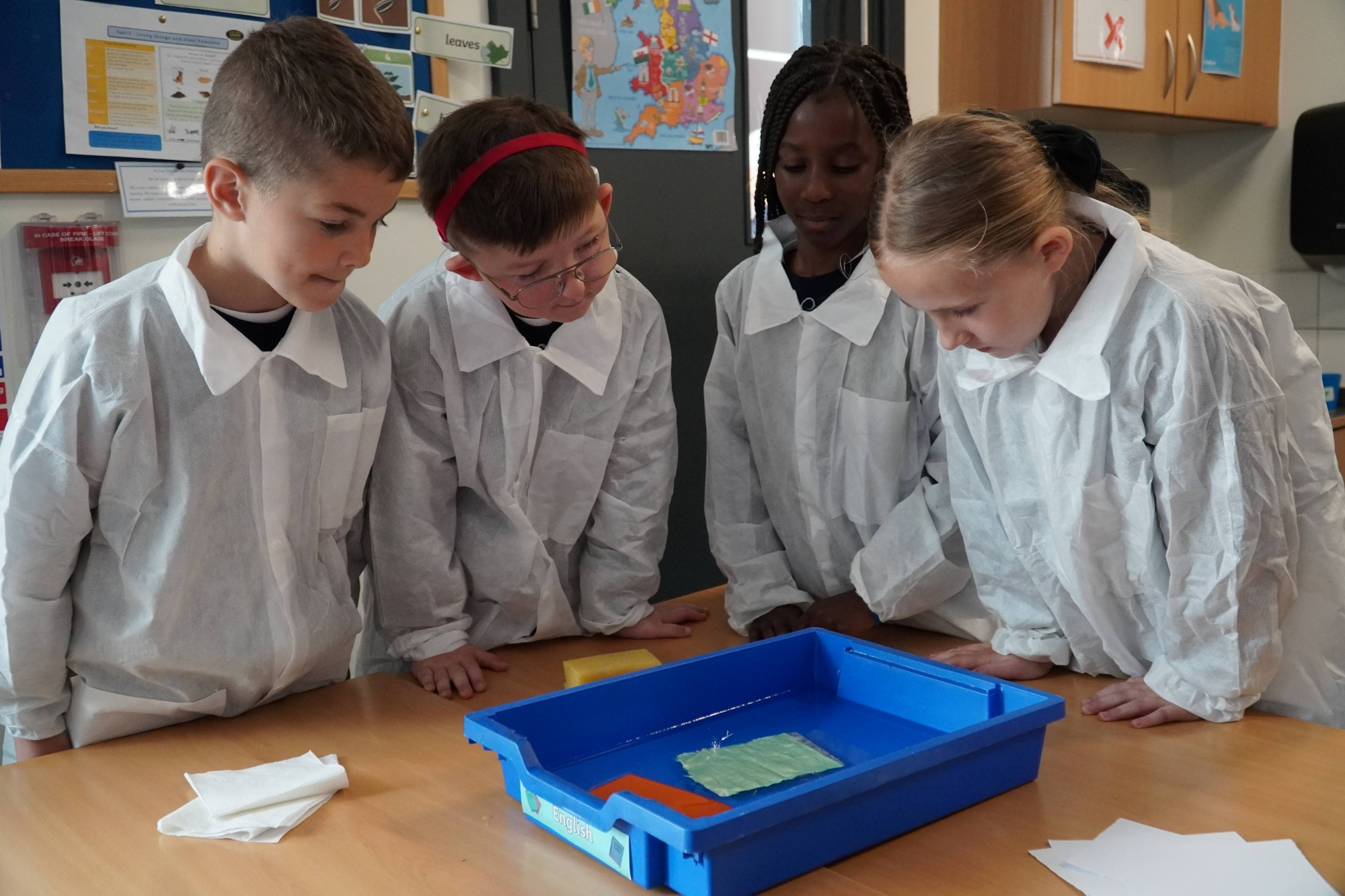
Year 2 pupils say, “Science is fun! We ask and answer questions and try to find things out. I have loved learning about plants and different seeds. We dissected fruit to see the different kinds of seeds. They were all different shapes and sizes. It was very satisfying!” During science week, a Year 4 pupil commented, "This was the best Science lesson! The balloon rockets and lava lamps experiments were very interesting and fun! I cannot wait to show my parents at home what I have learned!"
The science curriculum promotes curiosity and a love and thirst for learning. It empowers our children to become independent and resilient – like all curriculum areas.
We enrich the children’s time in our school with memorable experiences and provide opportunities which may otherwise be out of reach.
For instance, Year 5 and 6 attend Into University which included learning all about Astrology and Forensic science. During their visit the children develop their working-scientifically skills, including observation, prediction and experimentation. In addition, we have a wonderful school allotment where the all children are able to grow plants and vegetables as part of their science topics. The children have all had the opportunity to plant with the school gardener. All school councillors have also worked with the gardener to plant and learn about different plants from around the world to represent the different cultures within our school. Each year the children take part in a science week where they enjoy extra science lessons and fun science activities before sharing their work through an interactive science fair. Year 5 take part in Water Sports activities at Crosby Lakeside which gives them real life experiences of air and water resistance. The children have had the opportunity to visit North Liverpool Academy and take part in workshops and science demonstrations to create awe and wonder. Year 6 have had the opportunity to use specialised equipment and take part in enrichment lessons led by real scientist and North Liverpool Academy staff. This has complimented their Living things and their habitats topic.
We firmly believe that developing well rounded, lifelong learners is not just about what happens in the classroom, it is about the added value we offer that will really inspire our children.
Science Curriculum Implementation
To ensure high standards of teaching and learning in science, we implement a curriculum that is progressive throughout the whole school. The Science curriculum at Four Oaks Primary School is based upon the 2014 Primary National Curriculum in England, which provides a broad framework and outlines the knowledge and skills taught in each Key Stage. Teachers plan lessons based on both the required curriculum coverage and the children’s interests. A variety of teaching approaches are used based on teacher judgement, ensuring progression of knowledge and skills from year group to year group. Science teaching focuses on enabling children to think as scientists.
Various strategies are employed by staff throughout each topic to allow children to convey what they know already. This includes differentiated questioning, the use of concept cartoons, mind maps, concept maps and class discussion. This ensures that lessons are relevant and take account of children’s different starting points.
Science provides opportunities to enhance the learning of all pupils through working scientifically and a deeper level of questioning. Children are able to take the initiative in planning and carrying out scientific investigations. They are able to think independently and raise questions about working scientifically, giving extended verbal and written explanations.
At Four Oaks Primary School we provide a variety of opportunities for science learning inside and outside the classroom. At Four Oaks Primary School, the children experience science on educational visits and through effective use of the local environment such as seasonal walks within the school grounds and local parks. In Reception, the children have learnt about lifecycles and have had the wonderful experience of watching chicks hatch in an incubator in their own classroom. The children use the surrounding area and nearby parks to observe seasonal changes throughout the year. We also have our amazing 4D room which is able to take us anywhere in the world and thus explore different seasons and habitats. Year 5 have travelled to space and recreated the solar system through drama activities, using key vocabulary to describe the planets’ movements in our solar system in our interactive 4D room! Year 6 children had the opportunity to visit Martin Mere Wetland Centre. During the trip, the children participated in a science workshop linked to our current science topic focusing on evolution and the work of Charles Darwin. In the workshop, the children learn about adaptation and how this has enabled various species of animals to survive. Year 1 have visited Knowsley Safari Park where they observed different types of animals.
We value the following essential characteristics of scientists:
- The ability to think independently and raise questions about working scientifically and the knowledge and skills that it brings.
- Confidence and competence in the full range of practical skills, planning and carrying out scientific investigations.
- Scientific knowledge and understanding which is demonstrated in written and verbal explanations, solving challenging problems and reporting scientific findings.
- The ability to undertake practical work in a variety of contexts, including fieldwork.
- A passion for science and its application in past, present and future technologies.
Science Curriculum ImPact
The teachers complete tracking documents which detail any pupils who have not fully grasped a concept or skill. It is not uncommon for there to be a nil return or a very small number of pupils listed. Any pupil who has not confidently grasped a skill or knowledge will be supported through one or more of the following interventions:
- Keep up
- Catch up
- Pre-teach
This section should be read in conjunction with our Assessment and Interventions document found here.
Aims of Science:
The national curriculum for science aims to ensure that all pupils:
-
Foster curiosity and a love of science by inspiring children to enjoy science, explore the world around them, and develop lifelong interest and ambitions in scientific careers.
-
Develop scientific knowledge and understanding by building knowledge of the natural and physical world through progressive learning from Nursery to Year 6.
-
Promote scientific skills and thinking by enabling children to ask questions, plan and carry out investigations, observe, predict, and analyse results independently.
-
Encourage critical thinking and problem-solving by supporting children in reasoning, explaining their findings, and applying science to real-life contexts.
-
Connect science to the wider world by providing meaningful, practical experiences through experiments, educational visits, use of the local environment, and enrichment activities.
Nursery
Children explore natural materials using all their senses, compare properties, and describe their observations with a growing vocabulary. They begin to understand their own life story and family history, investigate how things work, plant and care for seeds, and observe the life cycles of plants and animals. Children develop respect for the natural environment and living things, explore different forces, and notice and describe changes in materials.
REception
Children explore the natural world around them, observing and describing what they see, hear, and feel. They begin to recognise environments different from their own and develop an understanding of how changing seasons affect the natural world.
Key Stage 1
In Year 1, children study animals, including humans, learning about the human body and different animals. They explore seasonal changes, observing evergreen and deciduous trees, identifying common plants, and learning about parts of plants and trees. In everyday materials, children investigate the names and properties of simple materials. They also study plants, focusing on bulbs, and explore living things and their habitats, including suitable habitats and simple food chains.
In Year 2, children continue to develop their understanding of plants, including bulbs and seeds, and animals, including humans. They further investigate living things and their habitats, focusing on suitable habitats and simple food chains. In uses of everyday materials, children explore the suitability of different materials and how their shapes can be changed, building on prior learning from Year 1.
Key Stage 2
- In Year 3, children explore animals, including humans, focusing on nutrition and movement. In forces and magnets, they investigate pushes, pulls, and magnetic interactions, while light includes studying shadows. Plants are studied through seed dispersal, and children examine rocks and soil. Later in the year, they extend their understanding of plants by learning about the parts of flowers and their life cycle.
- Year 4 children study living things and their habitats, recognising that living things can be grouped in different ways and observing changes in habitats. They explore states of matter, including solids, liquids, gases, heating and cooling, and the water cycle. In electricity, they construct simple circuits, while sound and animals, including humans are studied through the digestive system and food chains.
- In Year 5, children investigate forces and develop their understanding of properties and changes of materials, including thermal and electrical conductivity, mixing and separating, and reversible and irreversible changes. Living things and their habitats focus on life cycles and reproduction, while earth and space introduces planetary and solar system concepts. In animals, including humans, they study the changes that occur as humans grow.
- Year 6 children extend their study of living things and their habitats through classification. In animals, including humans, they examine the circulatory system. Light is explored with a focus on how we see and how light travels, while electricity involves creating circuits with components and symbols. Finally, evolution and inheritance covers fossils, adaptation, and the broader concept of evolutionary change.


