At Four Oaks Primary School, we recognise that computing is an essential skill for life in an ever-changing, technology-driven world. Our curriculum equips pupils with the knowledge, creativity, and problem-solving abilities they need to use technology confidently, responsibly, and imaginatively. By combining the principles of computer science with practical digital skills and strong online safety education, we ensure that pupils not only understand how technology works, but also how to use it effectively and ethically.
Through engaging lessons, hands-on programming, and innovative resources such as our state-of-the-art immersive 4D room, children are inspired to think critically, collaborate, and explore the creative possibilities of the digital world. We aim to develop confident, adaptable, and digitally literate learners who are well-prepared for the opportunities and challenges of the future.
Further Information:
Progression Maps:
Computing Curriculum Intent
At Four Oaks Primary School, we believe it is our responsibility to provide all children with the skills and knowledge to manage an ever-changing and increasingly technological world. A high-quality computing curriculum equips pupils to use computational thinking and creativity to understand and change the world. We will ensure our children embody our core value to ‘strive to be the best we can be’.
We believe that technology can provide enhanced collaborative learning opportunities, better engagement of pupils and access to a range of innovative, exciting software to explore the technological world around them. For example, our children are able to enrich their learning across the curriculum by through the use of our state-of-the-art 4D room. This uses projected video footage on floor-to-ceiling screens, sound, lighting, and an interactive floor space to create an ‘immersive’ experience. When Little Acorns read ‘We’re going on a Bear Hunt’, the 4D room enabled the children to be immersed in the different stages of the story. The children then paired actions with the different parts of the story. The experience our children receive in the 4D room is priceless as it ignites curiosity in understanding how the technology is used and programmed for a purpose whilst providing an immersive experience within a topic.
Computing is composed of three main strands which underpin children’s understanding of the computing curriculum. These are:
- Computer Science: the core of computing; pupils are taught the principles of information and computation, how digital systems work, and how to put this knowledge to use through programming.
- Digital Literacy: ensuring pupils are able to express themselves and use technology at a level suitable for their future workplace. Pupils understand the online world and know how to navigate this safely and with appropriate behaviour.
- Information Technology: pupils are equipped with the ability to use technology to purposefully create, organise and develop work using a range of programs and software.
We want to equip children with not only the minimum statutory requirements of the Computing National Curriculum, but to prepare them for the opportunities, responsibilities and experiences of later life. Pupils have an opportunity to develop a more critical media literacy as they work with tools that, until relatively recently, were the domain of professionals. Tools for recording audio and video, and for creating animation, web pages, digital photos, digital music are all used in school throughout the key stages. As children begin to develop skills in using a range of resources in computing, they begin to understand how these tools can be used by professionals.
We firmly believe in the importance of delivering a high quality, online safety curriculum to prepare our pupils for the wider world. This is embedded throughout our curriculum through the Knowsley CLC scheme of work as well as being explicitly taught in the ‘My Online Life’ units each year. As technology continues to develop, so does the need for a better understanding of how to use it in a safe and responsible manner. The education of online safety is essential, to ensure our pupils are equipped with the skills to recognise risks online, to be aware of the content they access and to understand how to validate information retrieved from the internet.
Computing Curriculum Implementation
To ensure high standards of teaching and learning in Computing, we implement a curriculum that is progressive throughout the whole school. Computing is taught as a new topic every half term, focusing on knowledge and skills stated in the National Curriculum. This helps to ensure sufficient time is allocated to Computing and that subject matter can be revisited. We believe that by crafting our curriculum this way, we improve the potential for our children to retain what they have been taught, to alter their long-term memory and thus improve the rates of progress they make.
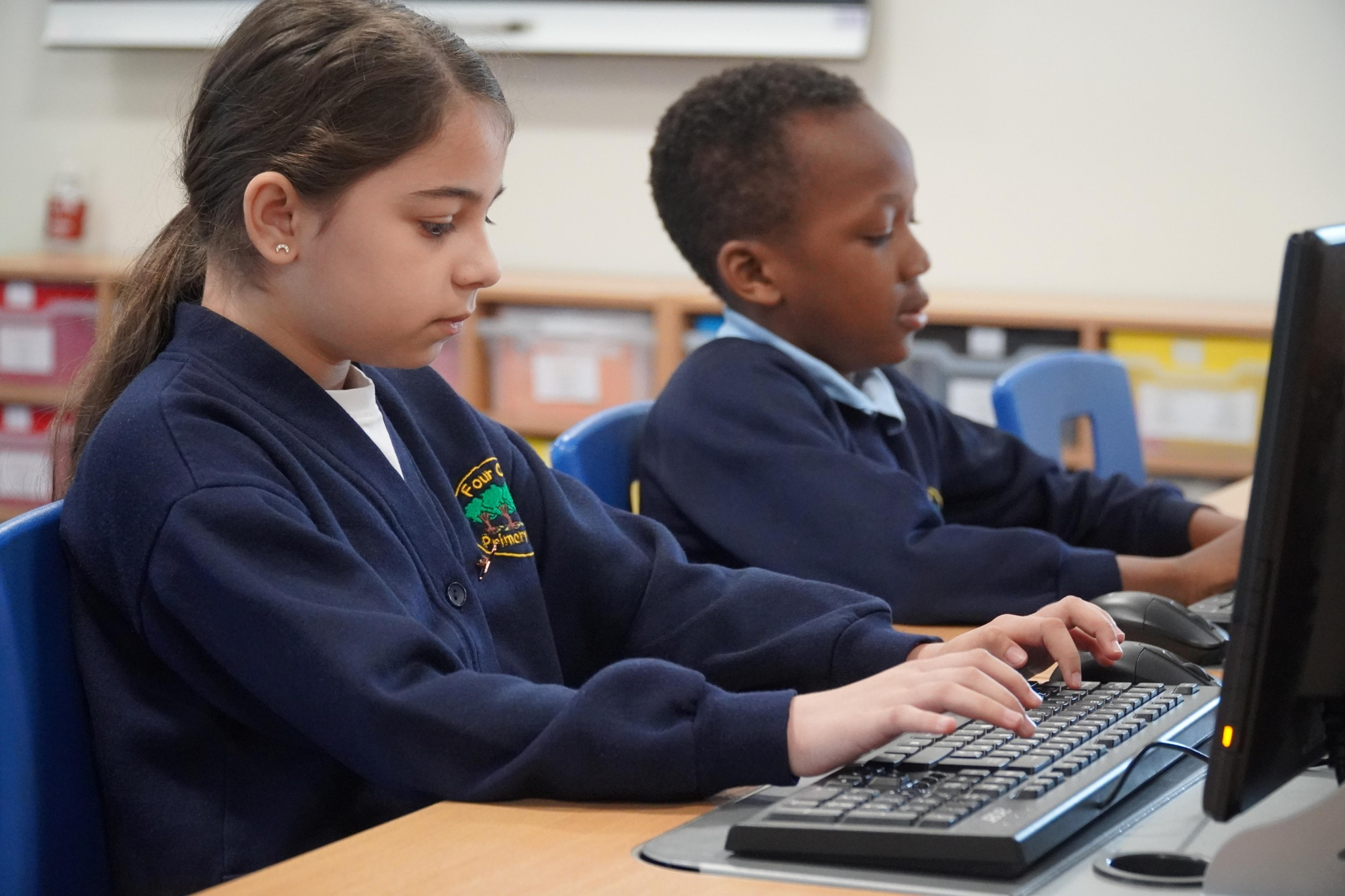
The delivery of computing and online safety is planned in line with the National Curriculum and allows for clear progression as pupils move through each stage of their education with us. Teachers use the ‘Knowsley CLC’ scheme of work to support their planning and delivery of the computing curriculum from Years 1-6. In EYFS, the teaching of key computing skills is embedded through continuous provision and key stories, to provide our pupils with a broad, play-based experience in a range of contexts. A variety of teaching approaches are used based on teacher judgement, ensuring progression of knowledge and skills from year group to year group.
We recognise the need to continually maintain, update and develop resources to ensure the effective delivery of the National Curriculum and support the use of technology throughout the school. This includes:
- Interactive whiteboards in every classroom to enhance and promote effective use of technology for learning.
- Teacher iPads in each classroom to be able to support teaching and learning.
- A range of iPads, Chromebooks and laptops from EYFS – Year 6 for pupil use within lessons.
- An interactive 4D room to immerse the children fully in their learning.
- A range of programmable devices including BeeBots.
- Subscription to online content (TT Rockstars) to promote learning in school and to support homework.
In Key Stage One, our pupils will:
- understand what algorithms are; how they are implemented as programs on digital devices; and that programs execute by following precise and unambiguous instructions.
- create and debug simple programs.
- use logical reasoning to predict the behaviour of simple programs.
- use technology purposefully to create, organise, store, manipulate and retrieve digital content.
- recognise common uses of information technology beyond school.
- use technology safely and respectfully, keeping personal information private; identify where to go for help and support when they have concerns about content or contact on the internet or other online technologies.
In Key Stage Two, our pupils will:
- design, write and debug programs that accomplish specific goals, including controlling or simulating physical systems; solve problems by decomposing them into smaller parts
- use sequence, selection, and repetition in programs, work with variables and various forms of input and output.
- use logical reasoning to explain how some simple algorithms work and to detect and correct errors in algorithms and programs.
- understand computer networks including the internet; how they can provide multiple services, such as the world wide web; and the opportunities they offer for communication and collaboration.
- use search technologies effectively, appreciate how results are selected and ranked, and be discerning in evaluating digital content.
- select, use and combine a variety of software (including internet services) on a range of digital devices to design and create a range of programs, systems and content that accomplish given goals, including collecting, analysing, evaluating and presenting data and information.
- use technology safely, respectfully and responsibly; recognise acceptable/unacceptable behaviour; identify a range of ways to report concerns about content and contact.
We also believe in the importance of providing a wider range of opportunities and technology beyond the classroom. For example, in Year 5 the children have been able to take part in an unplugged workshop with Digital School House to enrich their learning about binary and understanding how this is used in technology. The children were also able to use Nintendo Switch consoles to take part in a class e-sports tournament, to illustrate how competitive gaming has become an industry that provides jobs and entertainment.
Children have also had the opportunity to attend a VEX Robotics club where they learned to build and program their own robot. The children then attended a competition at the North Liverpool Academy with other schools to take part in a robot race.
Computing Curriculum Impact
The teachers complete tracking documents which detail any pupils who have not fully grasped a concept or skill. It is not uncommon for there to be a nil return or a very small number of pupils listed. Any pupil who has not confidently grasped a skill or knowledge will be supported through one or more of the following interventions:
- Keep up
- Catch up
- Pre-teach
This section should be read in conjunction with our Assessment and Interventions document found here.


