At Four Oaks Primary School, Religious Education plays a vital role in helping pupils understand the beliefs, values, and traditions that shape communities both locally and globally. Our RE curriculum inspires curiosity, respect, and open-mindedness, encouraging children to explore faiths and world views with empathy and understanding. Through engaging lessons, interactive experiences, and links with our local church, pupils gain a deeper awareness of how religious beliefs influence everyday life and personal values. We encourage them to reflect on their own ideas, ask thoughtful questions, and consider the perspectives of others, fostering both critical thinking and mutual respect.
Religious Education Intent
At Four Oaks we are theologists! We want our children to love Religious Education. We want them to have no limits to what their ambitions are and grow up enabled to become priests, anthropologists, lecturers or social workers!
We want them to embody our core values: we all “strive to be the best we can be”. The RE curriculum has been carefully crafted so that our children develop their skills. We want our children to remember their RE lessons in our school, to cherish these memories and embrace the RE opportunities they are presented with! We have a strong link with Christ Church in Hartnup Street and are fortunate enough to have assemblies every other week with Reverend David Gavin. One Year 4 pupil said, “We look forward to the vicar’s assemblies every Wednesday. We sing different songs and always learn something new. For example, this week, we learnt about the Holy Spirit and how it can help to achieve whatever we put our minds to!” We also participate in the very popular ‘Messy Church’. The pupils thoroughly enjoy the experience with one Year 2 pupil commenting, “Messy Church is fun because I get to do different activities with my family!”
The Religious Education curriculum promotes curiosity and a love and thirst for learning. It is ambitious and empowers our children to become independent and resilient – like all curriculum areas.
We want to equip them with not only the minimum statutory requirements of the religious education National Curriculum but to prepare them for the opportunities, responsibilities and experiences of later life. For example, during the Christmas period the different key stages worked to create our ‘Christmas Performance’ which was published on our school website. After seeing the performance one parent commented, “It was lovely to see the children understanding what the true meaning of Christmas is. Well done!”
We want our children to use the vibrancy of our great city to learn from other cultures, respect diversity, co-operate with one another and appreciate what they have. We achieve this by providing a SMSC curriculum, with British Values and our core values placed at the heart of everything we do. This often feeds into the Religious Education curriculum. For example, within our school we have a display board which represents the different countries and languages which are represented within school. Pupils can visit this display and are able to link up with other children who can speak the same language as them or who are from the same country.
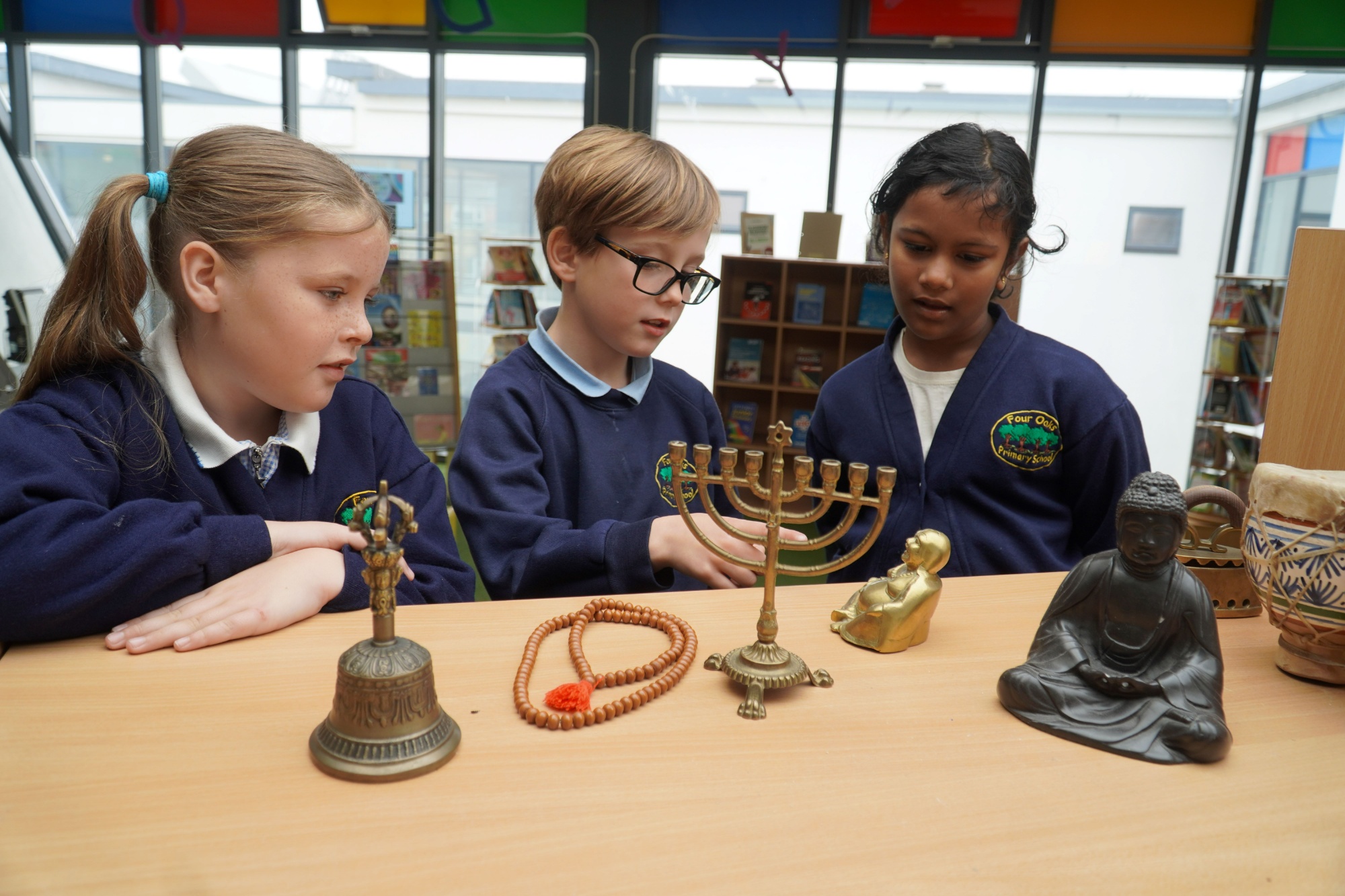
We enrich the children’s time in our school with memorable experiences and provide opportunities which may otherwise be out of reach. During RE lessons, resources are used to enhance the children’s learning such as prayer mats, holy books and items found within a sacred place. The children relish in having these opportunities with a Year 2 pupil commenting, “When we were learning about Mosques, we had a prayer mat inside our classroom. We looked at the detail and the dial which points to Mecca. I tried praying like a Muslim would on their pray mat.” We firmly believe that it is not just about what happens in the classroom, it is about the added value we offer to really inspire our children.
RE Curriculum Implementation
At Four Oaks the Religious Education curriculum has been carefully built and the learning opportunities for each year group crafted to ensure progression and repetition in terms of embedding key learning, knowledge and skills. At Four Oaks we follow RE Today, the agreed syllabus for Liverpool. Children are taught to understand and respect the importance of religious beliefs in the world around them. One pupil from Year 1 commented, “We learn about different religions and talk about how they are different. We learn lots of different things. I know that The Prophet Muhammad is the God for Muslims.” The syllabus aims to allow pupils to explore themes and concepts within religion drawing on beliefs from a range of different faiths and world views. We aim to ensure that the RE curriculum is challenging, dynamic and relevant to pupils of all ages. That is why an enquiry approach was implemented, encouraging higher order thinking and allowing our children to explore in a way that is meaningful to them.
Religious Education subject specific skills, which we expect the children to demonstrate, have been developed and shared with all members of staff who deliver RE - both school staff and outside agencies. This underpins all work in RE and forms a focal point for display areas and provides a common subject specific vocabulary for staff and pupils. We develop the following characteristics:
- An understanding and knowledge of religions.
- An engagement with a range of ultimate questions about the meaning and significance of existence.
- The ability to ask significant and reflective questions about religion and demonstrate an understanding of issues related to the nature, truth and value of religion.
- An understanding of how the beliefs, values, practices and ways of life within any religion cohere together.
- Independence; the ability to think for themselves and take the initiative when asking questions, carrying out investigations, evaluating ideas and working constructively with others.
- Originality, imagination or creativity, which are shown in their responses to their learning in RE.
- The ability to link the study of religion and belief to personal reflections on meaning and purpose.
- A wide knowledge and deep understanding across a wide range of religions and beliefs.
We empower our staff to organise their own year group curriculums under the guidance of our subject leaders. Teachers are best placed to make these judgements. The vast majority of subjects are taught discretely but staff make meaningful links across subjects. They link prior knowledge to new learning to deepen children’s learning.
Religious Education is taught regularly throughout the year, typically as a weekly lesson. This helps to ensure sufficient time is allocated to religious education and that the subject matter can be revisited frequently. We believe that by crafting our curriculum this way, we improve the potential for our children to retain what they have been taught, to alter their long-term memory and thus improve the rates of progress they make.
RE Curriculum Impact
The teachers complete tracking documents which detail any pupils who have not fully grasped a concept or skill. It is not uncommon for there to be a nil return or a very small number of pupils listed. Any pupil who has not confidently grasped a skill or knowledge will be supported through one or more of the following interventions:
- Keep up
- Catch up
- Pre-teach
This section should be read in conjunction with our Assessment and Interventions document found here.
Our teaching goes beyond the statutory requirements, providing enriching opportunities such as visits, guest speakers, artefact exploration, and whole-school celebrations of religious festivals. These experiences help to make learning memorable and relevant, while embedding British Values and our school’s own core values. We aim to nurture pupils who are not only knowledgeable about a variety of faiths but also able to live harmoniously in a diverse society.
In line with national guidance, we recognise that parents and carers have the legal right to withdraw their child from all or part of Religious Education. Any families wishing to do so are encouraged to discuss this with the school so that alternative arrangements can be made.
Further Information:
Knowledge Organisers:
YEAR 6
Progression Maps:
Religious Education in Action


