At Four Oaks Primary School, music is an integral part of our pupils’ learning and personal development. We believe every child is a musician, with the potential to create, perform, and appreciate music in its many forms. Our curriculum nurtures a love of music through active participation in singing, playing instruments, composing, and listening to a wide range of genres.
From classroom lessons to high-profile performances at events such as Young Voices, pupils gain the skills, confidence, and creativity to express themselves musically. We connect learning to real-world experiences – from performing for local community groups to attending live concerts – helping children to understand music’s cultural, historical, and emotional impact. By providing both structured teaching and enriching opportunities, we inspire pupils to develop their musical talents, broaden their horizons, and carry a lifelong appreciation of music into the future.
Further Information:
Progression Maps:
Music Curriculum Intent
At Four Oaks we are musicians! We want our children to love music. We want them to have no limits to what their ambitions are and grow up enabled to become performers, songwriters, recording engineers, music therapists or music producers. We want them to embody our core values: we all “strive to be the best we can be”. We want our children to remember their music lessons in our school, to cherish these memories and embrace the musical opportunities they are presented with!
At Christmas, pupils enjoyed performing to parents and friends in class performances and our choir performed Christmas carols for residents in a local care home. The choir also enjoying performing for an audience in the Co-op Arena in Manchester, at the Young Voices Choir. These examples of enrichment activities help to bring music alive at Four Oaks.
The music curriculum promotes curiosity and a love and thirst for learning. It empowers our children to become independent and resilient – like all curriculum areas. We want to equip pupils with not only the minimum statutory requirements of the music National Curriculum but to prepare them for the opportunities, responsibilities and experiences of later life.
We enrich the children’s time in our school with memorable experiences and provide opportunities which may otherwise be out of reach. We firmly believe that it is not just about what happens in the classroom, it is about the added value we offer to really inspire our children and support them to become well rounded, lifelong learners.
Music Curriculum Implementation
To ensure high standards of teaching and learning in Music, we implement a curriculum that is progressive throughout the whole school. Music is taught as part of a half-termly topic, focusing on knowledge and skills stated in the National Curriculum. This helps to ensure sufficient time is allocated to Music and that subject matter can be revisited. We believe that by crafting our curriculum this way, we improve the potential for our children to retain what they have been taught, to build on prior learning and thus improve the rates of progress they make.
The Music curriculum at Four Oaks Primary School is based upon the 2014 Primary National Curriculum in England, which provides a broad framework and outlines the knowledge and skills taught in each Key Stage. Teachers plan lessons based on the required curriculum coverage, the Charanga Scheme of work and the children’s interests. A variety of teaching approaches are used based on teacher judgement, ensuring progression of knowledge and skills from year group to year group. Music teaching focuses on enabling children to think as musicians.
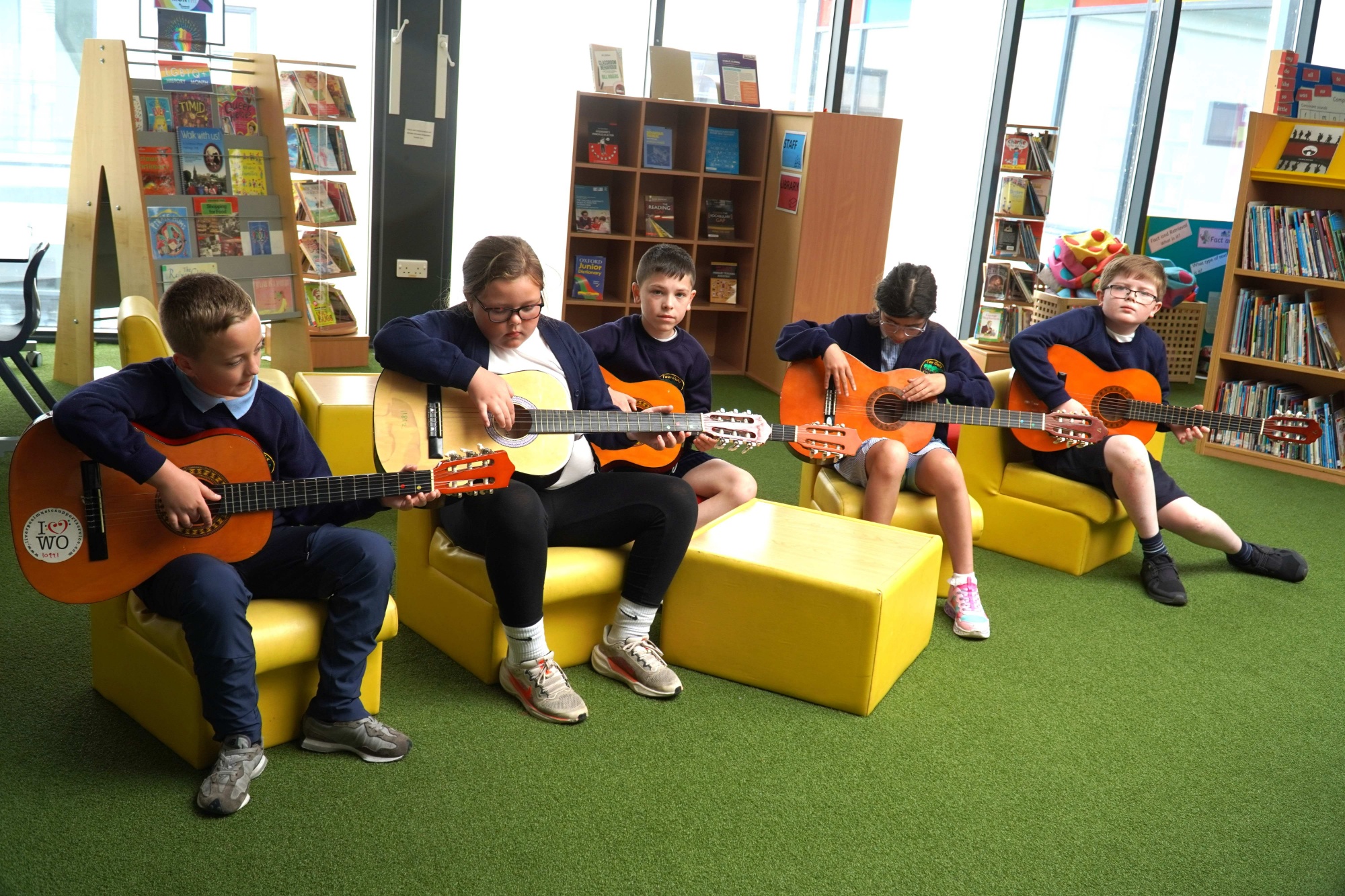
At Four Oaks Primary School we provide a variety of opportunities for music learning inside and outside the classroom. For example, each week Year 4 pupils have the opportunity to learn to play the guitar and they have the opportunity to accelerate their learning by joining a lunchtime guitar club. All KS2 pupils are also welcome to join this club whether they have any prior guitar skills or not. The children take part in performances for the school and their parents. This offers an opportunity for parents to engage with the school and enjoy listening to what their children have been learning.
Educational visits are another opportunity for the teachers to plan for additional music learning outside the classroom. For example, Year 4 attend the Liverpool Philharmonic orchestra in the Spring term to experience different genres of music and a variety of instruments playing alongside the one they learn throughout the year. "I liked the way the instruments all played together and made one big sound!", commented a Year 4 child. Year 2 children learn and perform Beatles songs and take part in their own ‘Beatles Tour’ around the city, amalgamating their work in both music and history. “I enjoy listening to the Beatles as it is our history topic,” commented a Year 2 child. Our KS2 choir learnt songs and dances to participate in the Young Voices choir at Manchester, the heartbeat of music for primary schools across the UK, where children and teachers united in an electrifying choir experience. Young Voices say that through “unforgettable concerts, children discover their voices, gain confidence and create lasting memories.” This experience also allowed children to feel part of a wider community as they performed to their parents and a wider audience. The children commented, “I enjoyed dancing, singing and the light show!”
“I loved performing to the audience and our parents all said they loved it too!”
“I enjoyed watching the performances. Everything was great! I would love to do it again and be like David, the conductor!”
We develop the following essential characteristics of musicians:
- A musical understanding underpinned by aural perception, internalisation and knowledge of music, including developing levels of technical expertise.
- A good awareness and appreciation of different musical traditions and genres.
- A widening repertoire which they use to create original, imaginative, fluent and distinctive composing and performance work.
- An understanding of how musical provenance – the historical, social and cultural origins of music – contributes to the diversity of musical styles.
- The ability to give written and verbal explanations, using musical terminology effectively, accurately and appropriately.
- A passion for and commitment to a diverse range of musical activities.
Music Curriculum Impact
The teachers complete tracking documents which detail any pupils who have not fully grasped a concept or skill. It is not uncommon for there to be a nil return or a very small number of pupils listed. Any pupil who has not confidently grasped a skill or knowledge will be supported through one or more of the following interventions:
- Keep up
- Catch up
- Pre-teach
This section should be read in conjunction with our Assessment and Interventions document found here.
Music In Action


