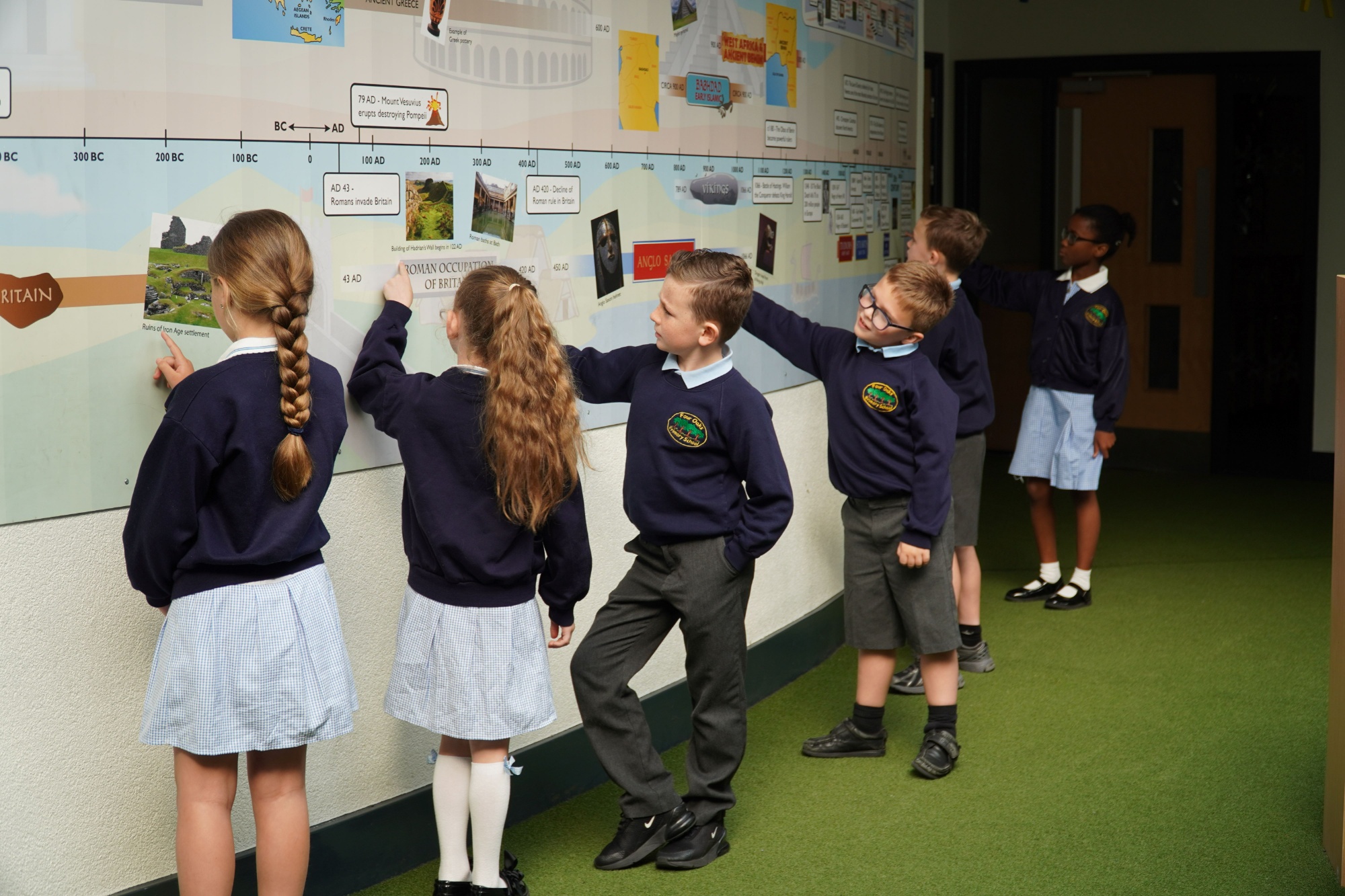
At Four Oaks Primary School, we are passionate about bringing the past to life and inspiring children to think, question, and learn like historians. Our curriculum is designed to spark curiosity, deepen understanding, and encourage pupils to explore how people and events have shaped the world we live in today. By combining the rigour of the National Curriculum with immersive experiences such as museum visits, expert workshops, and hands-on artefact exploration, we ensure that history is both meaningful and memorable. Pupils are encouraged to analyse sources, form reasoned arguments, and appreciate different perspectives, developing both their knowledge of the past and their critical thinking skills. In doing so, we aim to equip every child with a strong historical foundation and a lifelong interest in understanding and learning from history.
Further Information:
Progression Maps:
History Curriculum Intent
At Four Oaks we are historians! We want our children to love History. We want them to have no limits to what their ambitions are and grow up enabled to become historians, teachers, researchers, archivists, museum curators, archaeologists or research analysts. We want them to embody our core values: we all “strive to be the best we can be”. We want our children to remember their history lessons in our school, to cherish these memories and embrace the historical opportunities they are presented with.
For example, our Year 6 pupils enjoyed visiting the Liverpool War Museum – The Western Approaches. They walked through hidden rooms and explored the stories locked in the WWII bunker that protected the tactics of the British Armed Forces plotting to bulwark the Western Approaches and aid the Allied victory. They also completed the marching drills acting like soldiers and sent messages using Morse and Enigma codes. A Year 6 child commented, “I really enjoyed visiting the museum. It was incredibly interesting and sad at the same time. We must remember what happened so we can learn from the past!” Bringing History alive is important at Four Oaks Primary School. The History curriculum promotes curiosity and a love and thirst for learning. It empowers our children to become independent and resilient – like all curriculum areas.
We want to equip pupils with not only the minimum statutory requirements of the History National Curriculum but to prepare them for the opportunities, responsibilities and experiences of later life. For example, our Year 3 children were extremely lucky to receive a special visit from a local archaeologist, who has travelled the world discovering and researching artefacts. He brought with him some amazing items he had found and taught the children all about the Stone Age and its different time periods. The children thoroughly enjoyed the archaeologist’s workshop and could hardly contain their excitement when they were given the opportunity to handle some real-life artefacts. We hope to see him again next year. “I remember that we used flint and iron to make fire! It was very interesting to see how people made fire a long time ago!” “My favourite part was comparing the size of a mammoth and megalodon’s tooth to our heads! I couldn’t believe how big the teeth were!” commented Year 3 children. The local archaeologist kindly added, “I really enjoyed teaching the children and they were two great classes. Also, your school had a "very warm and friendly" atmosphere about it. When I teach children, I aim to give 100% effort & interest so that I totally engage the children without losing their attention. I do find it inspiring that young children can be so interested in the Stone Age.”
We want our children to use the vibrancy of our great city to learn from other cultures, respect diversity, co-operate with one another and appreciate what they have. We achieve this by providing an SMSC curriculum, with Four Oaks’ British ‘Golden’ Values at the heart of everything we do. This often feeds into the History curriculum. For example, in July, Year 2 went on the Beatles Tour around Liverpool to explore and learn about the most famous places. Their first stop was the gate of the famous Strawberry fields, closely followed by a short visit to John Lennon’s childhood home on Menlove Avenue. The children were fascinated by the fact they could experience their curriculum in reality. One of the children commented, “I can’t believe we have been to John Lennon’s house, how lucky are we!”
Their next stop was a guided tour in Paul McCartney’s house. The children sat in his living room, took photographs in his garden, and practised singing his songs in his bathroom like he used to do, due to the echo and acoustic sound it produced. The children were amazed and excited and told the teachers, “This is the best day ever!” The tour continued on Penny Lane whereby they visited the famous street sign and a replica of the zebra crossing on Abbey Road that featured on the album covers. The children enjoyed having their photo taken crossing the famous crossing! The final visit was to the pier head to see the statue of the four Beatles members. It was a day thoroughly enjoyed by all and one that brought the local history topic to life.
We enrich the children’s time in our school with memorable experiences and provide opportunities which may otherwise be out of reach. We firmly believe that developing well rounded, lifelong learners is not just about what happens in the classroom, it is about the added value we offer that will really inspire our children. “I love learning about Liverpool’s history, for example, The Beatles. Their music is very good!” commented a Year 2 child.
History Curriculum Implementation
To ensure high standards of teaching and learning in History, we implement a curriculum that is progressive throughout the whole school. History is taught over three half terms per year, focusing on knowledge and skills stated in the National Curriculum. This helps to ensure sufficient time is allocated to History and that subject matter can be revisited. We believe that by crafting our curriculum this way, we improve the potential for our children to retain what they have been taught, to alter their long-term memory and thus improve the rates of progress they make.
The History curriculum at Four Oaks Primary School is based upon the 2014 Primary National Curriculum in England, which provides a broad framework and outlines the knowledge and skills taught in each Key Stage. Teachers plan lessons based on both the required curriculum coverage and the children’s interests. A variety of teaching approaches are used based on teacher judgement, ensuring progression of knowledge and skills from year group to year group. History teaching focuses on enabling children to think as historians. History provides excellent opportunities to enhance the learning of all pupils through the investigations, analysing sources and writing extended pieces.
At Four Oaks Primary School we provide a variety of opportunities for History learning inside and outside the classroom. Educational visits provide history learning outside the classroom. For instance, pupils in Year 6 visited the Maritime Museum, where they explored fascinating stories about the different people on the famous ship, the Titanic. They compared and acted out the lives of various classes. “It was fascinating to hear and learn about different people on the Titanic! I really enjoyed the experience! I appreciate the opportunity we had to visit the museum. I learned a lot of things I did not know!” commented a Year 6 child. At the end of each topic pupils celebrate their learning by recalling their knowledge and skills.
We develop the following characteristics of historians:
- A knowledge and understanding of people, events, and contexts from a range of historical periods and of historical concepts and processes.
- The ability to think critically about history and communicate ideas confidently in styles appropriate to a range of audiences.
- The ability to consistently support, evaluate and challenge their own and others’ views using detailed, appropriate and accurate historical evidence derived from a range of sources.
- The ability to think, reflect, debate, discuss and evaluate the past, formulating and refining questions and lines of enquiry.
- A passion for history and an enthusiastic engagement in learning, which develops their sense of curiosity about the past and their understanding of how and why people interpret the past in different ways.
- A respect for historical evidence and the ability to make robust and critical use of it to support their explanations and judgments.
History Curriculum Impact
The teachers complete tracking documents which detail any pupils who have not fully grasped a concept or skill. It is not uncommon for there to be a nil return or a very small number of pupils listed. Any pupil who has not confidently grasped a skill or knowledge will be supported through one or more of the following interventions:
- Keep up
- Catch up
- Pre-teach
This section should be read in conjunction with our Assessment and Interventions document found here.
Knowledge Organisers:
History In Action


